Grade 2 • Level 8
CogAT Test Prep for Grade 2: Level 8 Guide
Grade 2 preparation sits at an important transition point: students still benefit from picture-based directions, but the rules and distractors can require more careful, multi-step reasoning.
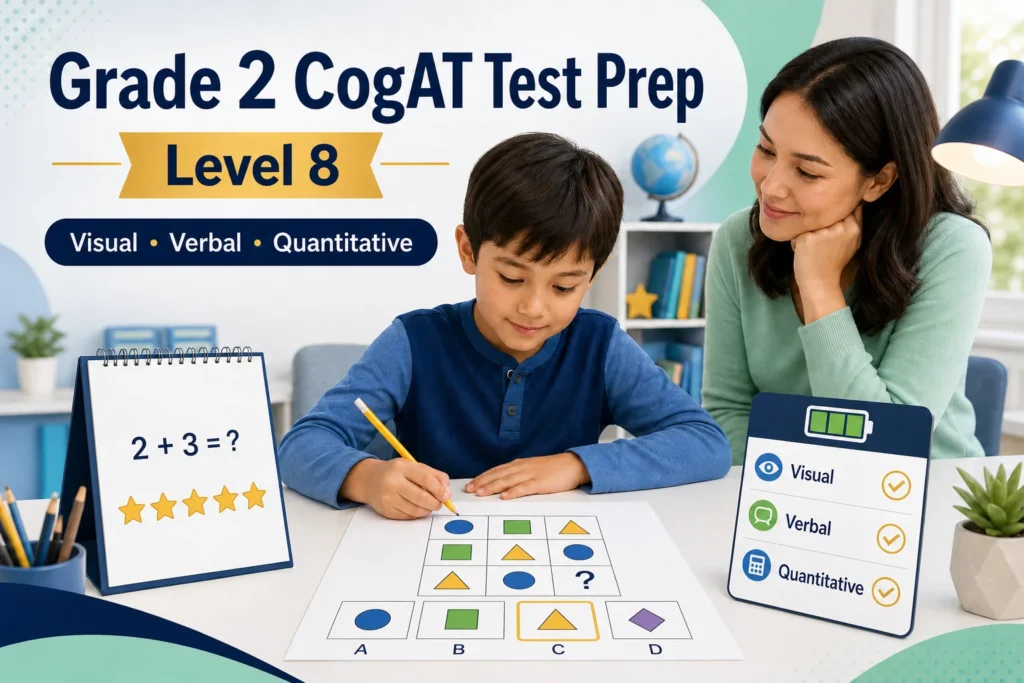
Know what to expect
Grade 2 CogAT level and format
Level 8 is commonly associated with Grade 2 and is generally the highest primarily pictorial level. A school may select a different level based on its testing window, group needs, and purpose.
Prepare with purpose
What to practice for Grade 2
Holding two parts of a rule in mind, comparing close answer choices, explaining numerical relationships shown in pictures, and checking visual transformations precisely.
Relationships and categories
Practice identifying the exact connection between ideas, completing a thought, and explaining why items belong in the same group.
Verbal practice optionsNumber rules and structure
Practice describing how quantities or numbers are related before applying the rule to a new pair, series, or puzzle.
Quantitative practice optionsFigures and spatial change
Practice tracking attributes such as position, direction, size, quantity, shading, and structure across figures.
Nonverbal practice optionsA manageable routine
Two-week Grade 2 CogAT prep plan
Suggested rhythm: 15–18 minutes, four times per week. Adjust the schedule to the student’s attention, school date, and experience.
Week 1: Directions and focused practice
Review each primary question family and identify which directions or relationships are unfamiliar. Work untimed until the process is accurate.
Week 2: Mixed practice and confidence
Alternate focused practice with balanced mixed sets. Introduce light pacing only after the student can explain the reasoning.
Parent coaching language
Have the student name what stays the same and what changes. Ask the student to eliminate choices with evidence instead of relying on a first impression.
Review the reasoning step
Common Grade 2 preparation mistakes
- Finding one correct feature but overlooking a second part of the rule.
- Switching strategies before carefully examining rows, columns, or pairs.
- Practicing only a favorite battery and avoiding less familiar formats.
The goal of review is to identify the reasoning step that needs attention. A wrong answer may come from misunderstanding directions, overlooking part of a rule, calculation, visual tracking, pacing, or fatigue.
Move from guidance to practice
Start Grade 2 CogAT practice
Use original questions across all three batteries, then return to this guide to adjust the preparation plan based on the formats that need more familiarity.
Quick answers
Grade 2 CogAT test-prep FAQs
What CogAT level is commonly used in Grade 2?
Level 8 is a common quick-reference match for Grade 2, but the school chooses the actual level based on its testing window, group needs, and program purpose.
How should a second-grade student prepare for CogAT?
Have the student name what stays the same and what changes. Ask the student to eliminate choices with evidence instead of relying on a first impression. Use original questions, learn the directions before adding speed, and practice all batteries the school plans to administer.
How much practice should a student do?
A reasonable starting rhythm is 15–18 minutes, four times per week, but concentration and confidence matter more than completing a fixed number of minutes. Stop or shorten a session when reasoning quality declines.
Can practice predict the student’s CogAT score?
No. Practice can build familiarity with directions and reasoning formats, but it cannot predict an official score, percentile, gifted-program eligibility, or placement decision.