Printable score report guide
Understanding CogAT Scores Visual Guide
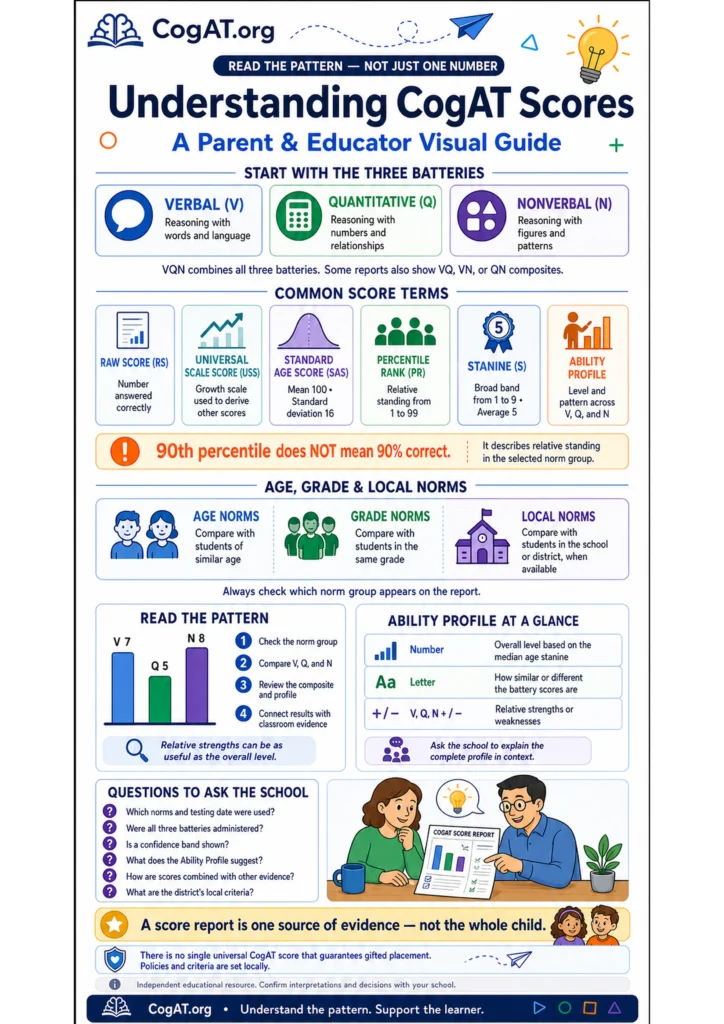
Read the pattern across Verbal, Quantitative, and Nonverbal results—not just one number. This A4 guide explains common score types, norm groups, composites, Ability Profiles, and practical questions to ask the school.
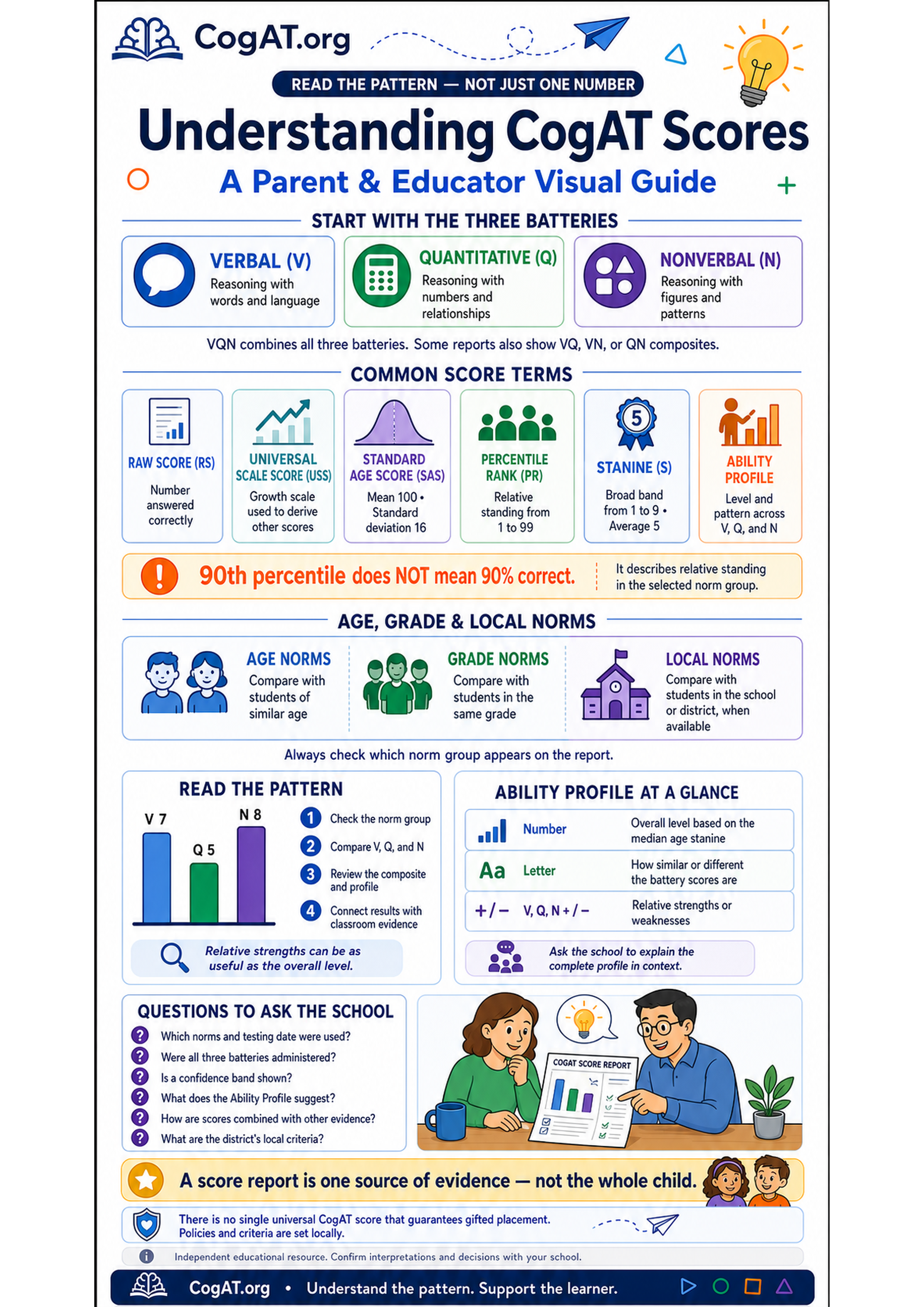
Accessible text version of the visual guide
Editorial review: July 22, 2026
Start with the three CogAT batteries
Verbal (V)
Reasoning with words
Shows how a student reasons with words and language.
Quantitative (Q)
Reasoning with numbers
Shows how a student reasons with numbers and relationships.
Nonverbal (N)
Reasoning with figures
Shows how a student reasons with figures and patterns.
Common CogAT score terms
- Raw Score (RS): the number of questions answered correctly.
- Universal Scale Score (USS): a continuous growth scale used to derive other score types.
- Standard Age Score (SAS): an age-normalized score with a mean of 100 and standard deviation of 16.
- Percentile Rank (PR): relative standing from 1 to 99 in the selected age, grade, or local comparison group.
- Stanine: a broad normalized band from 1 to 9, with an average of 5.
- Ability Profile: a summary of the level and pattern across Verbal, Quantitative, and Nonverbal batteries.
Percentile rank is not percent correct
A 90th percentile rank does not mean the student answered 90 percent of the questions correctly. It describes relative standing in the report’s selected norm group.
Read a score report in four steps
- Check whether the report uses age, grade, or local norms.
- Compare the Verbal, Quantitative, and Nonverbal battery results.
- Review the composite and the complete Ability Profile.
- Connect the report with classroom performance, achievement information, teacher observations, and other local evidence.
Questions to ask the school
- Which norms and testing date were used?
- Were all three batteries administered?
- Is a confidence band shown?
- What does the complete Ability Profile suggest?
- How are scores combined with other evidence?
- What are the district’s written local criteria?
Important: There is no single universal CogAT score that guarantees gifted placement. Policies and criteria are set locally.
Score report guide
CogAT Scores Explained
CogAT score reports can look confusing at first. The key is to understand what each score compares and what it can tell you about a student's reasoning profile.
A CogAT score report may include several score types. Parents often look first for a percentile or composite score, but the full report can be more useful than one number. CogAT scores can show whether a student is strongest in verbal, quantitative, nonverbal, or balanced reasoning.
Battery scores: verbal, quantitative, and nonverbal
CogAT reports often separate scores by battery. This is important because two students with the same composite score can have very different learning profiles. One student may have very high quantitative reasoning and average verbal reasoning. Another may show strong nonverbal reasoning with developing language skills. Educators can use these differences to plan better instruction.
What is a good CogAT score?
A "good" score depends on the purpose. For general classroom planning, average and above-average scores both provide useful information. For gifted identification, many districts look for high percentile ranks, but the exact cutoff varies. A 90th percentile score is strong. A 95th percentile score is very strong. Scores in the 97th to 99th percentile range are often considered highly advanced, but district rules decide what qualifies.
Why one score should not define a child
CogAT results are a snapshot of reasoning performance under specific testing conditions. Sleep, confidence, language familiarity, testing environment, and prior exposure to question types can all affect performance. A score can open useful conversations, but it should be considered alongside classroom performance, achievement data, teacher observations, creativity, motivation, and student interests.
Next: gifted qualification
If you are trying to understand whether a score may qualify for gifted services, read our detailed guide: What CogAT Score Qualifies as Gifted?
Ready to start practicing?
Use our free practice resources to help your child become familiar with CogAT-style reasoning questions without copying official test items.
How to read a CogAT score report in five steps
- Check the comparison group. Determine whether the report shows age norms, grade norms, local norms or more than one comparison.
- Review each battery. Verbal, quantitative and nonverbal results can reveal different relative strengths even when the composite score is similar.
- Separate score types. A raw score, Standard Age Score, percentile rank and stanine describe performance in different ways and should not be treated as interchangeable.
- Read the Ability Profile. The profile summarizes the overall stanine and whether battery results are relatively even or uneven.
- Ask how the school uses the results. Gifted identification rules, local norms and additional evidence vary by district.
Common CogAT score questions
Is a percentile rank the percentage of questions answered correctly?
No. A percentile rank describes a student’s standing within a comparison group. It is different from the percentage of test questions answered correctly.
Does one high score automatically qualify a student for gifted services?
Not universally. Districts may consider composite scores, individual batteries, local norms, achievement data, teacher input or other evidence. Always verify the published criteria used by the school district.
Why can battery scores be more useful than the composite?
The three battery results can show meaningful differences in how a student reasons with words, numbers and visual patterns. A composite can summarize overall performance but may hide those differences.
For official assessment information, consult Riverside Insights and the score-report guidance supplied by your school.