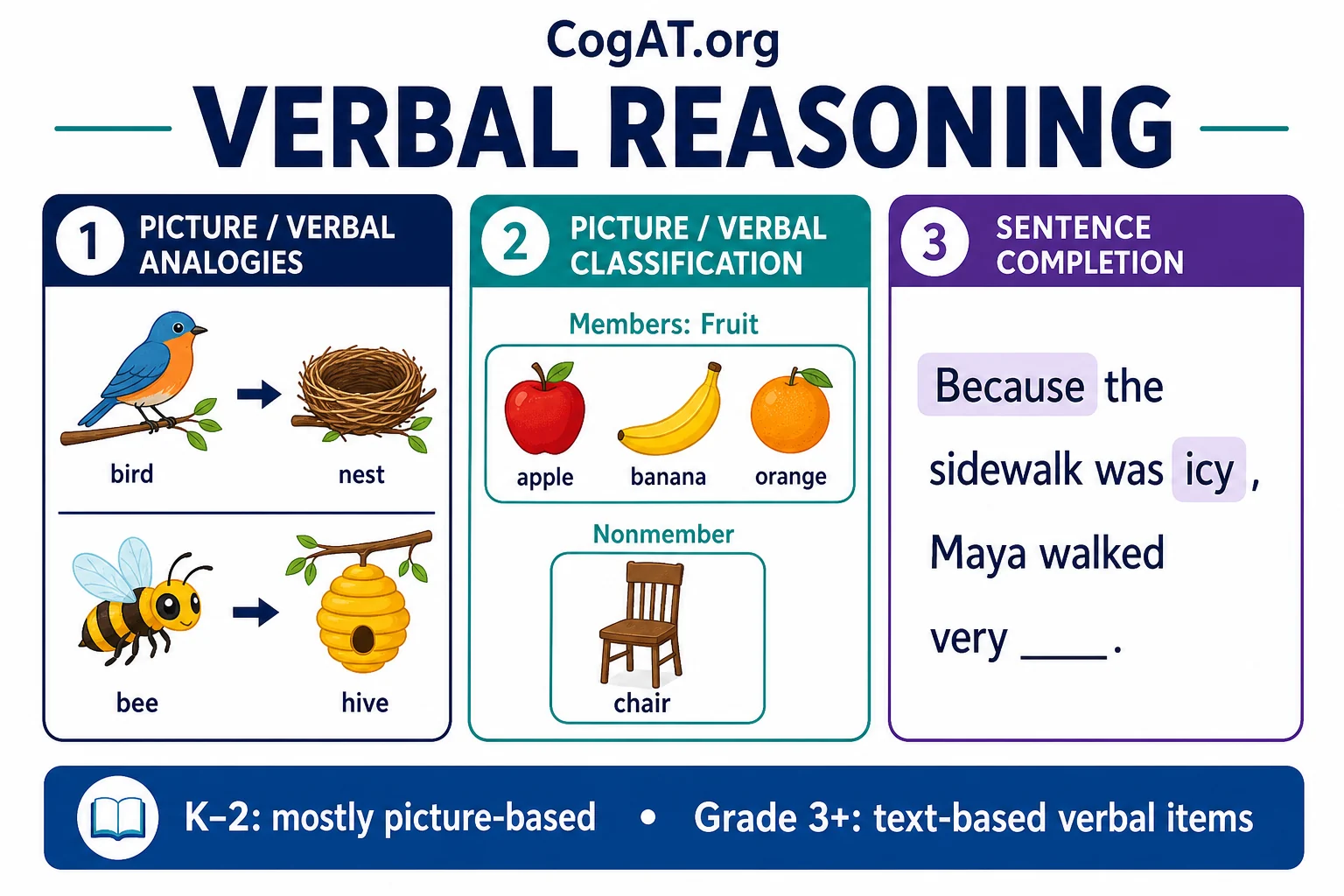
Verbal reasoning questions examine how students understand relationships expressed through words, concepts, categories, and language-based patterns.
The goal is not simply to reward a large vocabulary. Students must identify how ideas relate, determine which concepts share a rule, or choose language that completes a meaningful relationship. Vocabulary and language experience can still influence how easily a student accesses the task.
Common verbal skills
- Recognizing categories and identifying which word does not belong
- Completing analogies by naming the relationship between ideas
- Using context and meaning to complete a sentence or thought
- Comparing concepts by function, part, degree, sequence, or association
Explore verbal question families
Picture Analogies
Use visual vocabulary and relational thinking to solve Picture Analogies.
Sentence Completion
Use grammar and context clues to solve Sentence Completion questions.
Verbal Analogies
Learn to name word relationships and apply them in Verbal Analogies.
Verbal Classification
Identify the category or shared relationship in Verbal Classification questions.
A useful practice habit
Ask the student to state the relationship in a short sentence before choosing an answer: “A nest is a home for a bird.” That sentence can then be applied to the second pair. This keeps the student focused on the relationship instead of surface similarities.
Language note: A lower verbal result may reflect many factors. Families should interpret scores in context, especially for multilingual learners or students with language-related learning needs.
K-2 Primary Verbal Practice
For Kindergarten, Grade 1, and Grade 2 students, CogAT verbal reasoning often uses picture-based questions. Use these primary verbal practice pages for focused K-2 preparation:
What the CogAT Verbal Battery measures
The Verbal Battery focuses on reasoning with language, concepts and relationships. It is not simply a reading or spelling test. Students must understand how words or ideas relate, identify a precise category, and use context to complete a thought. At younger levels, related abilities may be represented with pictures and oral directions.
Reasoning skills involved
- Vocabulary in context rather than isolated memorization
- Part-to-whole, function, category, degree and cause-and-effect relationships
- Flexible classification when several words appear loosely related
- Using grammar and meaning together to complete a sentence
A repeatable solving method
- Read or listen to the entire prompt before considering choices.
- Name the exact relationship or meaning constraint.
- Predict a possible answer before reviewing distractors.
- Choose the option that satisfies both meaning and grammar.
Common mistakes to avoid
- Selecting a familiar word that does not fit the relationship
- Using only one clue from a sentence and ignoring the whole idea
- Treating vocabulary drilling as a substitute for explaining relationships
How to practice productively
Begin untimed and ask the learner to explain the rule or clue before choosing an answer. Review why each close distractor fails. Add short timed sets only after the method is accurate and familiar. This approach builds transferable reasoning instead of memorizing answers.
Independent educational resource: CogAT.org is not affiliated with or endorsed by the test publisher. Examples and practice materials are original and are not copied, recalled or secure test questions. Schools determine the assessment level, administration and use of results.