Quantitative reasoning questions examine how students recognize numerical relationships, discover rules, and use numbers to solve unfamiliar problems.
This battery is about reasoning with quantities rather than recalling a long list of school-taught procedures. Basic number sense helps, but successful solutions usually depend on noticing a relationship and applying it consistently.
Common quantitative skills
- Recognizing number patterns and sequences
- Finding equivalent relationships between pairs of numbers
- Determining the rule in a number puzzle
- Comparing quantities and identifying how values change
Explore quantitative question families
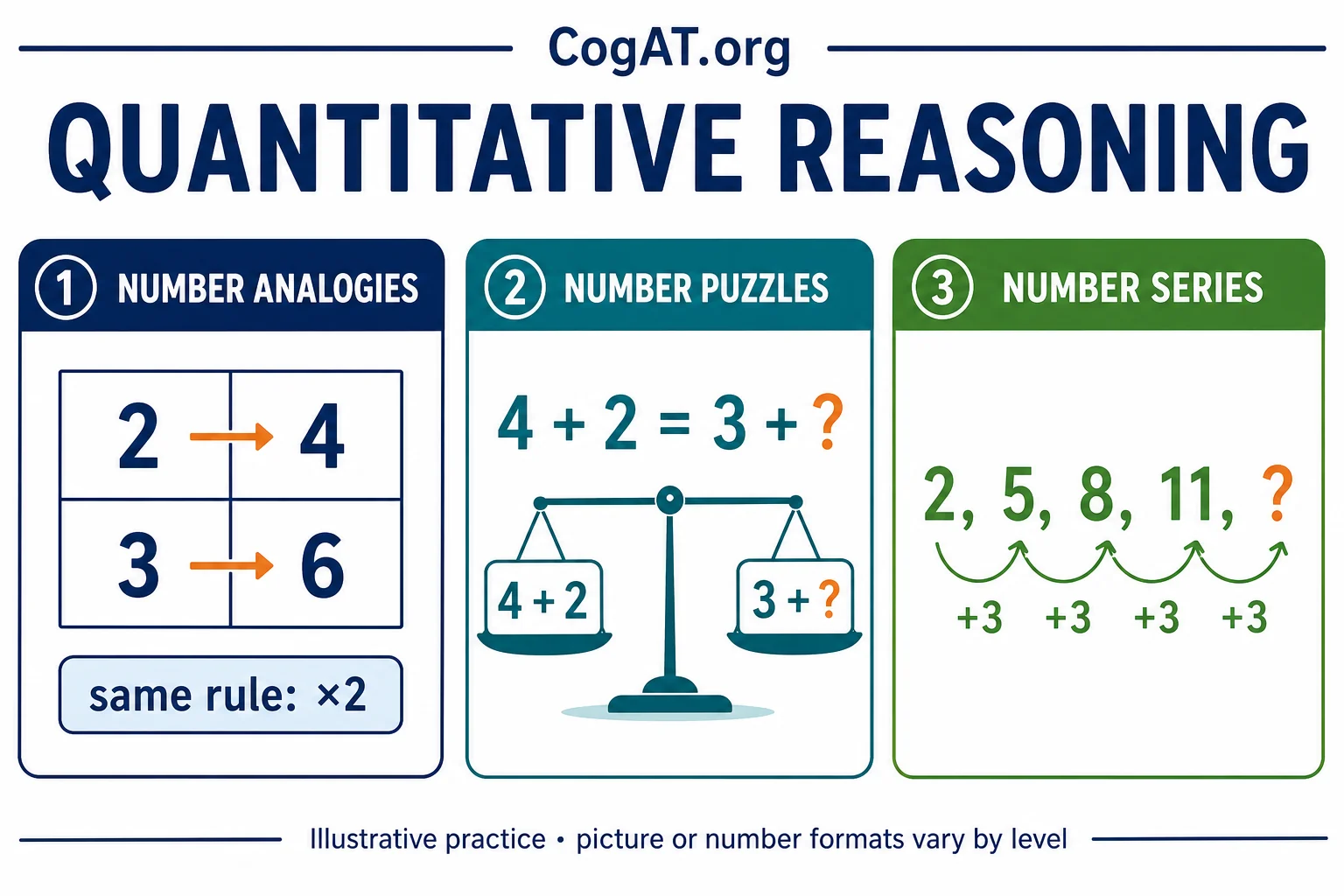
Number Analogies
Practice identifying and transferring numerical relationships in Number Analogies.
Number Puzzles
Use balanced relationships and missing-value reasoning to solve Number Puzzles.
Number Series
Find the changing rule in Number Series and predict the next value.
Quantitative Relations
Compare quantities efficiently in Quantitative Relations questions.
A useful practice habit
Have the student test a possible rule against every part of the problem. A rule that works once may be a coincidence; the best answer explains all the given relationships. Encourage estimates and mental math when they make the underlying pattern easier to see.
Preparation note: Learning arithmetic can support confidence, but CogAT preparation should emphasize flexible reasoning rather than speed drills alone.
K-2 Primary Quantitative Practice
Younger students often benefit from picture-based quantitative reasoning before moving into text-heavy number questions.
What the CogAT Quantitative Battery measures
The Quantitative Battery measures reasoning about numbers and quantities. Questions emphasize relationships, patterns and equivalence rather than speed with routine arithmetic. A student may need to recognize how two numbers are connected, extend a changing sequence, or determine an unknown value from balanced information.
Reasoning skills involved
- Recognizing additive, multiplicative and relational rules
- Finding constant, alternating and growing patterns
- Reasoning with equivalent quantities and unknown values
- Choosing an efficient strategy instead of calculating every possibility
A repeatable solving method
- Identify what changes and what stays constant.
- Test a simple rule against every number or quantity shown.
- Look for an alternating or two-step rule if one operation does not fit.
- Estimate or substitute the answer to confirm the relationship.
Common mistakes to avoid
- Assuming every problem requires the same operation
- Using a rule that fits only the first transition in a series
- Prioritizing calculation speed over understanding the relationship
How to practice productively
Begin untimed and ask the learner to explain the rule or clue before choosing an answer. Review why each close distractor fails. Add short timed sets only after the method is accurate and familiar. This approach builds transferable reasoning instead of memorizing answers.
Independent educational resource: CogAT.org is not affiliated with or endorsed by the test publisher. Examples and practice materials are original and are not copied, recalled or secure test questions. Schools determine the assessment level, administration and use of results.