Free visual guide
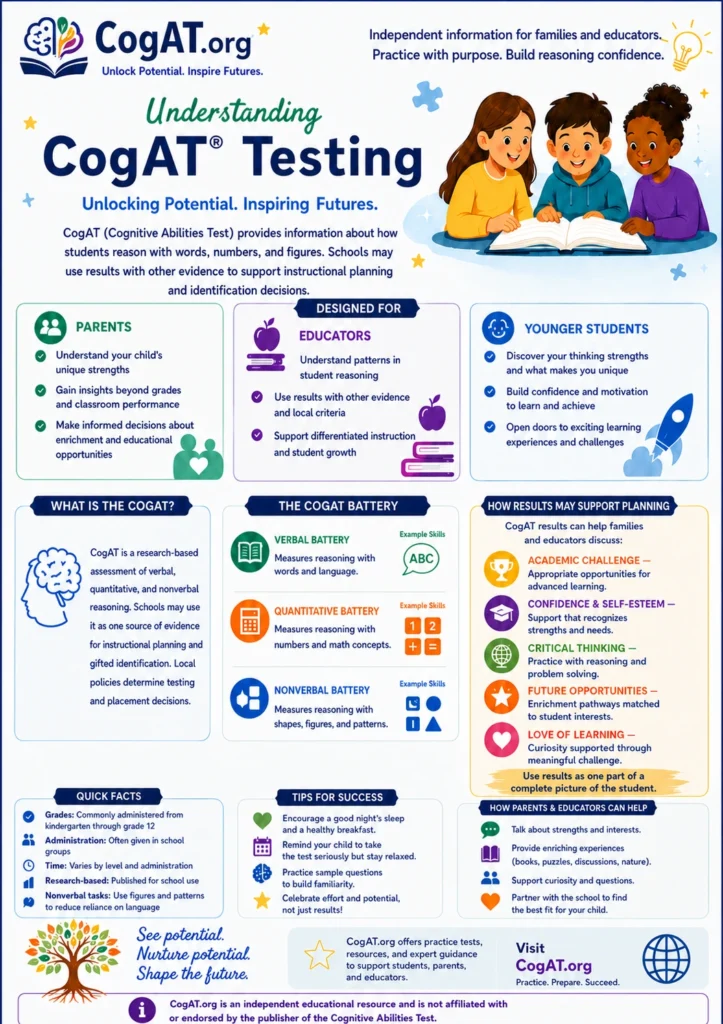
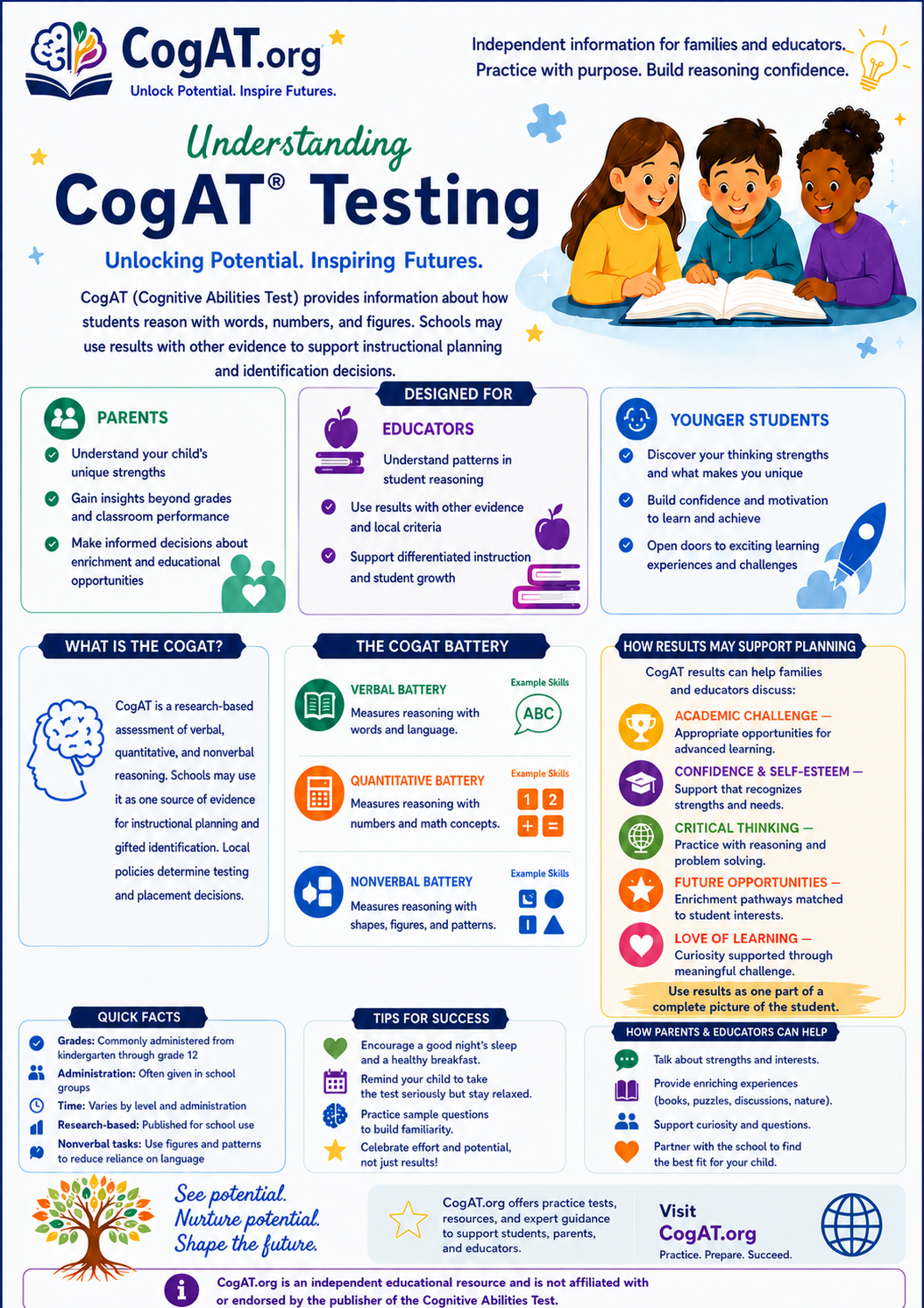
Use this parent- and educator-friendly infographic to understand what CogAT measures, how its three batteries differ, and how results may contribute to school conversations. The full text is provided below for accessibility and additional context.
Editorial review: July 21, 2026
What is the CogAT?
CogAT, the Cognitive Abilities Test, is a research-based assessment of reasoning. It describes patterns in how students reason with verbal, quantitative, and nonverbal information. It does not simply test memorized classroom facts, and it should not be treated as an IQ label or a complete description of a student.
Schools may use CogAT information as one source of evidence for instructional planning, advanced-learning discussions, or gifted identification. The exact form, testing schedule, score interpretation, eligibility rules, and placement decisions are controlled by the school or district. Families should ask for the local written policy before drawing conclusions from a score report.
The three CogAT batteries
Verbal Battery
Measures reasoning with words, language relationships, classifications, analogies, and related concepts. Primary levels may use picture-supported formats.
Quantitative Battery
Measures reasoning with numbers, mathematical relationships, sequences, analogies, and quantitative puzzles rather than routine calculation alone.
Nonverbal Battery
Measures reasoning with shapes, figures, patterns, classifications, and matrices. Figural tasks reduce reliance on language but should not be described as completely culture-free.
Who can use this information?
Parents and caregivers
Parents can use a CogAT report to ask better questions about a child's relative reasoning strengths, learning needs, classroom experience, and access to appropriate challenge. Results are most useful when considered alongside achievement, teacher observations, student work, interests, and other evidence.
Educators
Educators may examine patterns across batteries to inform differentiation and instructional conversations. A relative strength or weakness is a starting point for observation and support—not a reason to limit a student or assume that one instructional approach will always work.
Students
Students benefit from calm, age-appropriate explanations. Emphasize that the activity asks them to solve unfamiliar reasoning problems, that effort matters, and that one testing session never captures everything they can learn or contribute.
How CogAT results may support planning
When interpreted with other evidence, results can help families and schools discuss appropriate academic challenge, confidence and support, reasoning practice, enrichment pathways, and student interests. Strong decisions use a complete picture of the student rather than a single composite or cutoff.
For an official report, ask which CogAT form and level were administered, whether all three batteries were given, which age or grade norms were used, how the Ability Profile was determined, and how local identification criteria work. Use our questions to ask after receiving a CogAT score report as a conversation guide.
CogAT testing quick facts
- Grades and levels: CogAT forms and levels are commonly used from kindergarten through grade 12.
- Administration: Schools often administer CogAT in groups; local procedures vary.
- Timing: The number of items and testing time depend on the level, form, and administration plan.
- Batteries: Complete CogAT results may include Verbal, Quantitative, Nonverbal, and composite scores.
- Language load: Picture-based and figural tasks can reduce reliance on language, especially in primary levels.
Low-pressure preparation tips
Preparation should focus on familiarity, not memorizing secure questions. Help the student understand directions, see examples of common reasoning formats, sleep well, eat normally, and approach the session calmly. Short practice can build comfort with unfamiliar formats, but a practice result cannot predict an official CogAT score or gifted placement.
Sources and editorial note
This guide was written as independent educational information. Battery descriptions and grade/level context were checked against publisher materials, including Riverside Insights' explanations of the three CogAT batteries and the use of ability tests in gifted programs.
Independent-resource notice: CogAT.org is not affiliated with or endorsed by Riverside Insights or the publisher of the Cognitive Abilities Test. CogAT is a registered trademark of its respective owner. School and district policies control official testing and placement decisions.
Download or reference this infographic
Download the full-resolution image for personal educational reference. When linking to the infographic online, please use this page URL so readers can access the transcript, sources, and current version.
Download the CogAT testing infographic