Original nonverbal reasoning guide
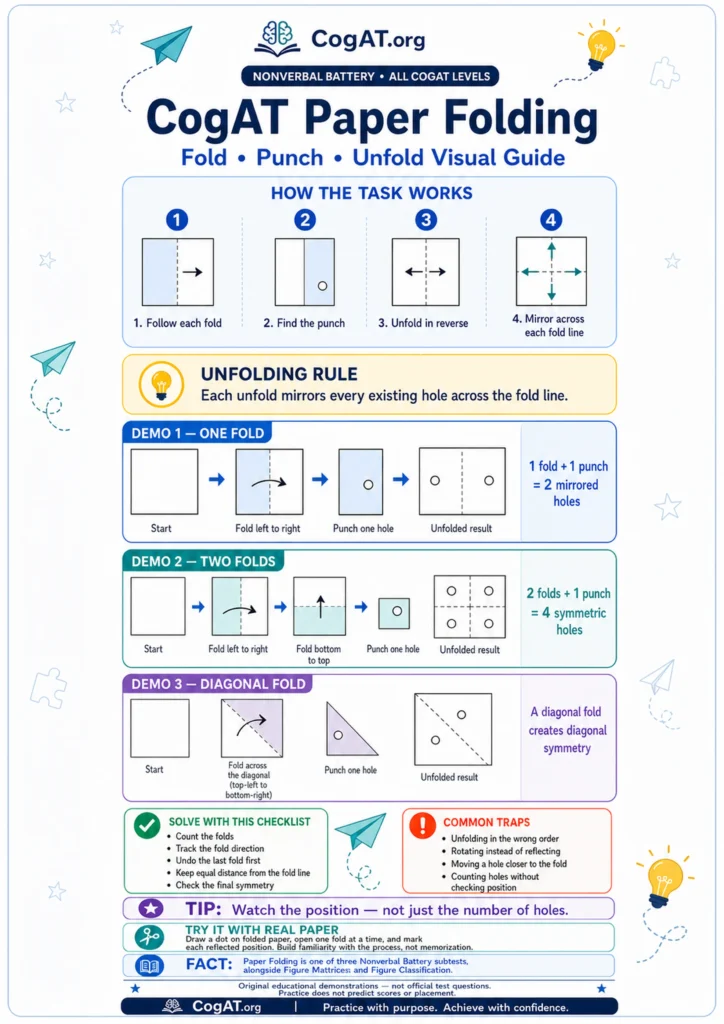
Paper Folding questions show paper being folded and punched or changed. Students mentally open the paper and select the result. The key is to undo the folds in reverse order and reflect every existing hole across each fold line.
Editorial review: July 22, 2026
What is CogAT Paper Folding?
Paper Folding is one of the three CogAT Nonverbal Battery subtests, together with Figure Matrices and Figure Classification. Official descriptions say students follow pictures of paper being folded and holes being punched, then choose how the paper looks when fully opened. The format appears across CogAT levels.
The Paper Folding reflection rule
Each unfold mirrors every existing hole across the fold line. The reflected hole stays the same perpendicular distance from the fold. Unfold the most recent fold first, then continue backward until the sheet is fully open.
- Follow each fold. Track the direction and identify the new folded shape.
- Find the punch. Notice its distance from every visible folded edge.
- Unfold in reverse. Undo the last fold before the first fold.
- Mirror each hole. Copy every existing hole across the active fold line at equal distance.
Three original Paper Folding demonstrations
One fold
One punch becomes two holes
After a vertical half-fold, opening the paper creates one matching hole on the other side of the center line.
Two folds
One punch becomes four holes
Undo the horizontal fold to make two holes, then undo the vertical fold to mirror both and make four.
Diagonal fold
The result has diagonal symmetry
The second hole appears across the diagonal at the same perpendicular distance from the fold line.
Common Paper Folding mistakes
- Wrong order: unfolding the first fold before the most recent fold.
- Rotation: turning a punch around a point instead of reflecting it across a line.
- Changed distance: placing the new hole closer to or farther from the fold.
- Counting only: choosing an answer with the right number of holes but incorrect positions.
- Missing a copy: forgetting that every existing hole mirrors at each unfold.
- Ignoring orientation: overlooking whether a fold is vertical, horizontal, or diagonal.
How parents and educators can help
Use a square sheet and a pencil dot. Fold the paper, place the dot on the folded shape, then open one fold at a time and mark each reflected position. Ask, “Which fold opens next?” and “Where is the equal-distance mirror point?” Keep practice brief and focus on explaining the process.
Frequently asked questions
Which CogAT battery includes Paper Folding?
Paper Folding is part of the Nonverbal Battery, alongside Figure Matrices and Figure Classification.
What does a CogAT Paper Folding question ask?
Students follow pictures of paper being folded and punched or changed, then choose how the sheet looks when it is completely opened.
What is the best Paper Folding strategy?
Undo the folds in reverse order. At each unfold, mirror every existing hole across that fold line at equal distance.
Does each fold always double the number of holes?
In a simple hole-punch demonstration where the punch passes through all layers and is away from a fold edge, each unfold doubles the visible holes. Position and symmetry still matter more than count alone.
Is Paper Folding used at every CogAT level?
Yes. Paper Folding is a Nonverbal Battery subtest across CogAT levels, with difficulty calibrated for the assessment level.
Are these official CogAT questions?
No. These are original educational demonstrations created by CogAT.org. Secure or publisher-owned questions are not reproduced.
Can practice predict a CogAT score or gifted placement?
No. Practice cannot predict an official score, percentile, eligibility decision, or placement outcome.