Original nonverbal reasoning guide
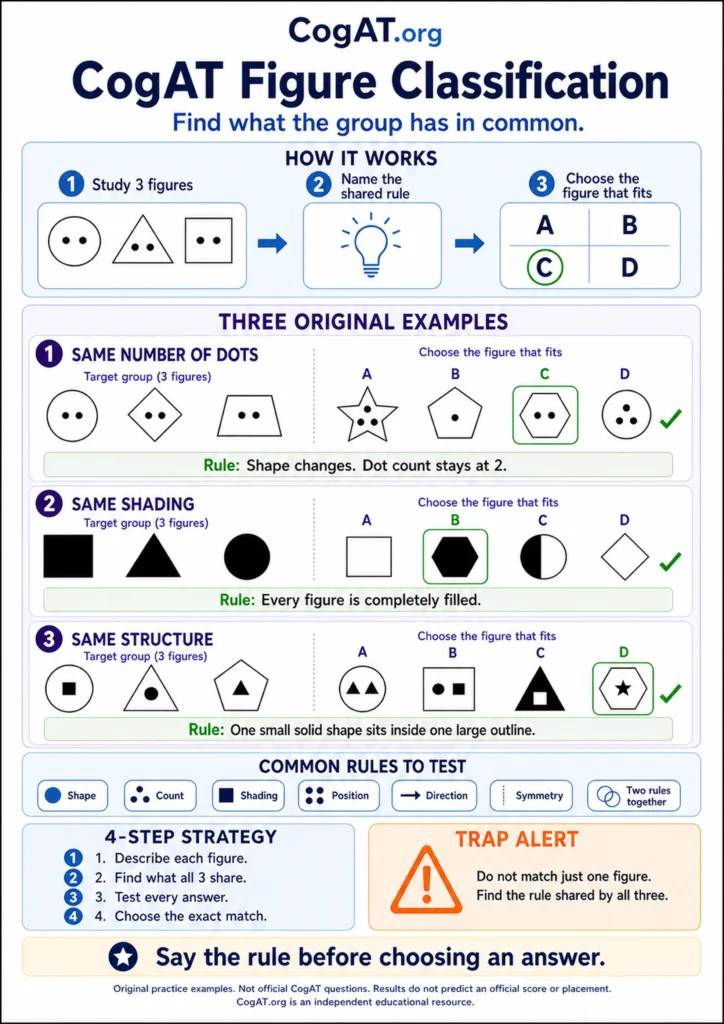
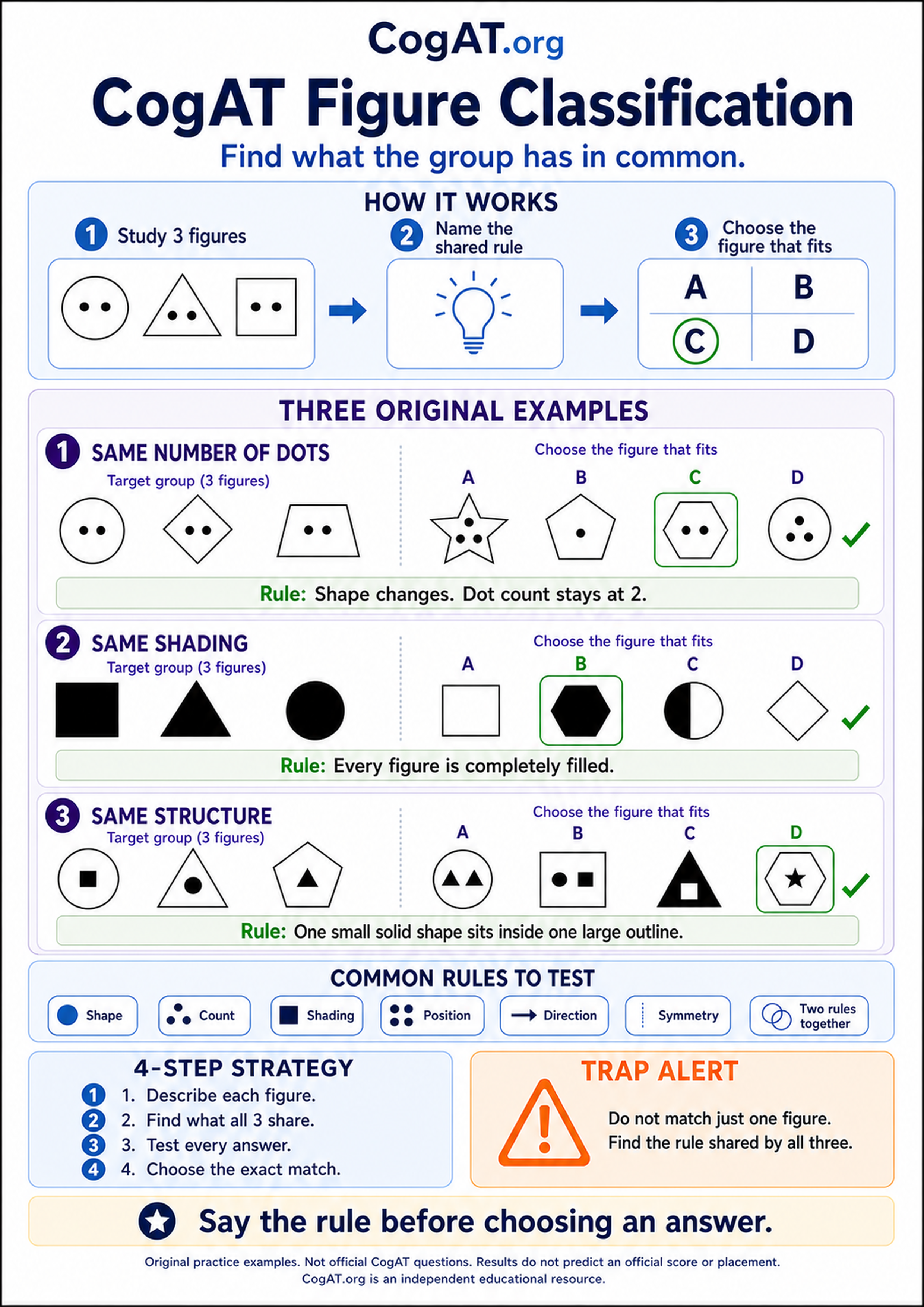
Figure Classification asks students to determine what three target figures have in common and select the answer that follows the same rule. The best rule must fit all three target figures, not just one of them.
Editorial review: July 22, 2026
What is CogAT Figure Classification?
Figure Classification is a Nonverbal Battery question type. Students inspect three figures, identify the visual property or combination of properties shared by all three, and choose the answer that belongs in the same group.
The core task is used across CogAT levels. At primary levels, questions are entirely pictorial and do not require reading. As levels advance, the figures and shared rules can become more complex, but the reasoning process remains: find the common rule and apply it exactly.
A four-step Figure Classification strategy
- Describe each target. Notice shape, number, shading, position, direction, and symmetry.
- Find what all three share. Reject a rule if even one target figure does not fit it.
- Test every answer. Compare each choice with the complete rule, not with only one target.
- Choose the exact match. If the group shares two attributes, the answer must match both.
Three original CogAT-style Figure Classification examples
Example 1: count
Every target contains exactly two dots
The outside shape changes, so shape is not the rule. Choice C belongs because it also contains exactly two dots.
Example 2: shading
Every target is completely filled
The targets use different shapes, but each is solid black. Choice B is the only answer that keeps the solid shading.
Example 3: structure
One small solid shape is inside one large outline
The specific shapes change while the inside-outside structure stays constant. Choice D matches that nested structure.
Common Figure Classification rules
- Shape: all targets use the same geometric form or type of line.
- Count: all targets contain the same number of dots, sides, parts, or objects.
- Shading: figures share solid, outline, striped, or partial filling.
- Position: an element appears inside, outside, above, below, or in the same relative location.
- Direction: figures point or rotate in a consistent way.
- Symmetry: each figure has the same kind of balance or mirror structure.
- Combined rule: difficult items may require two attributes, such as the same dot count and the same shading.
How parents and educators can help
Ask the student to say the rule before selecting an answer: “all have two dots,” “all are filled,” or “one solid shape is inside one outline.” Naming the rule makes guessing less likely and reveals whether the student checked all three targets.
When an answer looks similar to only one target, ask, “Does it fit the other two as well?” For more difficult problems, list two attributes separately and verify both.
Frequently asked questions
Which CogAT battery includes Figure Classification?
Figure Classification is part of the Nonverbal Battery, together with Figure Matrices and Paper Folding.
What does a Figure Classification question ask?
It presents three target figures that share a visual rule. The student selects the answer choice that is most like the target set because it follows the same rule.
What should a student check first?
Start with visible attributes such as shape, number, shading, position, direction, and symmetry. Keep a possible rule only if it fits all three target figures.
Can a question use more than one rule?
Yes. Some questions require a combination, such as the same shape and number of dots. The correct choice must satisfy every shared attribute.
Are these official CogAT questions?
No. The examples were independently created by CogAT.org to teach general classification reasoning. Secure or publisher-owned questions are not reproduced.
Can these examples predict a CogAT score or gifted placement?
No. Performance on practice-style examples cannot predict an official score, percentile, Ability Profile, eligibility decision, or placement outcome.