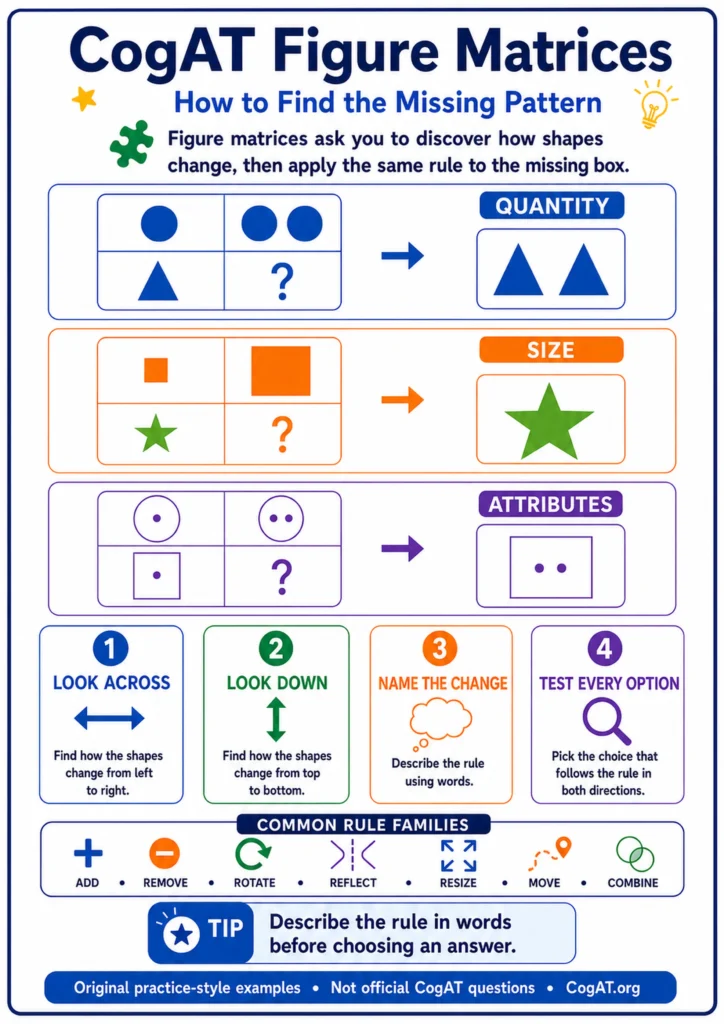
Original visual learning guide
Figure matrices ask students to identify how shapes change and apply the same relationship to a missing box. Use the original examples below to learn a repeatable strategy—not to predict an official score or placement decision.
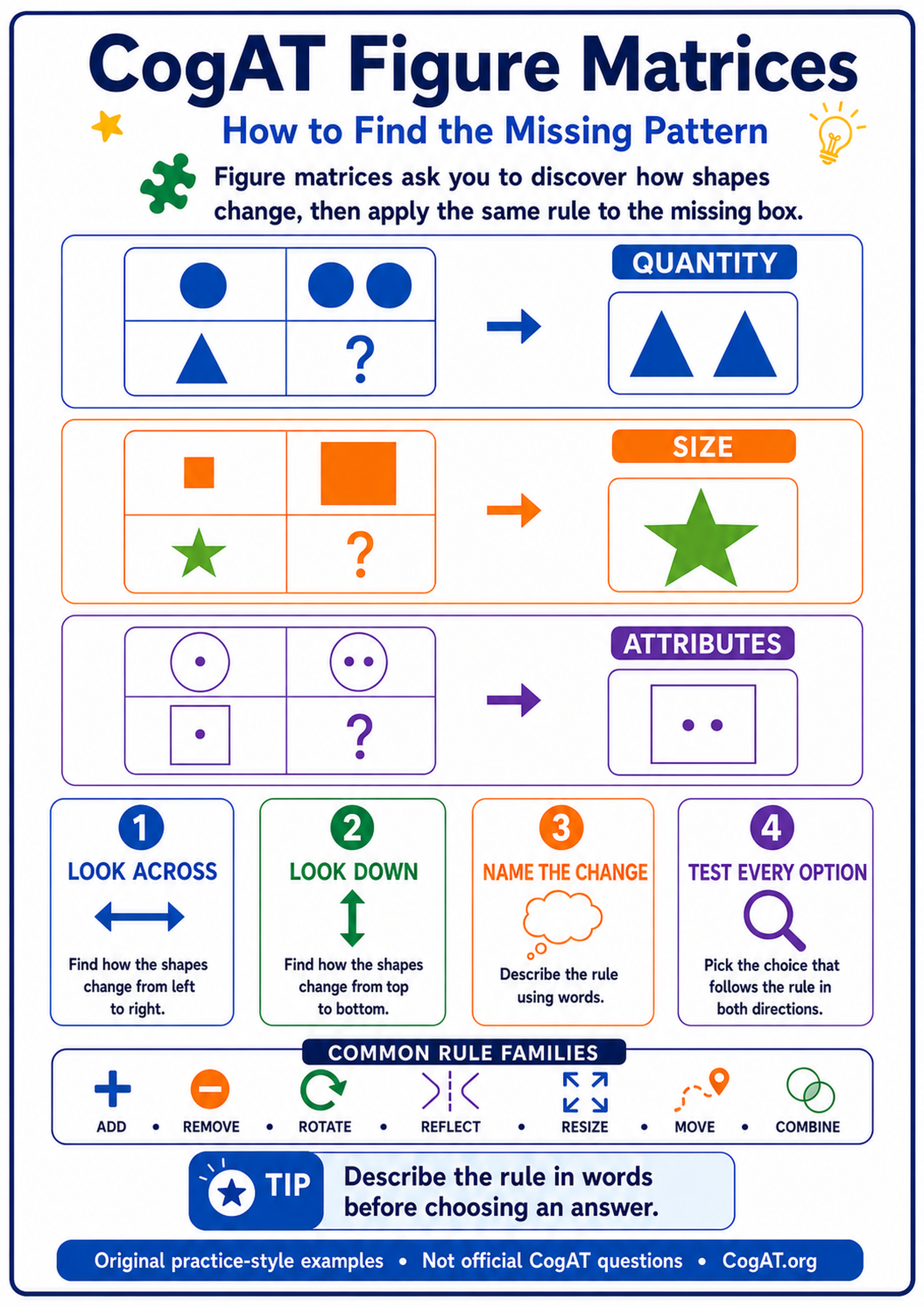
Editorial review: July 22, 2026
What are CogAT figure matrices?
A figure matrix is a visual reasoning puzzle arranged in rows and columns. One box is missing. The student studies the relationship among the visible boxes, identifies the transformation, and selects the choice that completes the same relationship. The important skill is not naming a shape; it is explaining what changed and applying that rule consistently.
Figure matrices are commonly discussed as part of nonverbal reasoning practice. Because the task relies heavily on figures, it can reduce—but does not eliminate—language demands. A matrix result should never be treated as a complete description of a child's ability.
A four-step method for solving figure matrices
- Look across. Compare the top-left and top-right boxes. Ask what was added, removed, moved, resized, rotated, reflected, recolored, or combined.
- Look down. Check the columns. The same rule may work vertically, or the row and column relationships may work together.
- Name the change. Put the rule into words before looking closely at the answer choices. A clear sentence prevents guessing from appearance alone.
- Test every option. Confirm that the selected answer satisfies the complete relationship. Eliminate choices that match only one feature.
Three original figure matrices examples
Example 1: Quantity
One becomes two
The top row changes from one blue circle to two blue circles. Apply the same quantity change to the bottom row: one blue triangle becomes two blue triangles.
Example 2: Size
Small becomes large
The orange square grows while keeping its shape and color. Apply the size change to the green star: the missing box is a large green star.
Example 3: Attributes
One dot becomes two
The outer figure stays the same while the number of inner dots increases from one to two. Apply that attribute change to the square: the answer is a square containing two dots.
Common rule families
- Add or remove: a shape, line, dot, or shaded region appears or disappears.
- Rotate or reflect: the figure turns or flips across an imaginary mirror line.
- Resize: the same figure becomes larger or smaller.
- Move: an object changes position inside the box.
- Change an attribute: color, shading, outline, direction, or quantity changes.
- Combine: parts from two boxes merge, overlap, cancel, or transfer.
Mistakes to avoid
Do not choose an option merely because it contains the same shapes. Check quantity, position, size, direction, color, shading, and interior details. Do not assume every puzzle uses only one change; older students may see two coordinated attributes. Finally, do not rush past the top row: it usually provides the clearest evidence for the rule.
How parents and educators can use these examples
Ask the student to describe the rule aloud: “one becomes two,” “small becomes large,” or “the outside shape stays while the dots increase.” Praise a clear explanation even before checking the answer. Short, calm practice builds familiarity with the format; it should not become repetitive drilling or a promise of gifted-program placement.
Frequently asked questions
Are these official CogAT questions?
No. Every example on this page was independently created by CogAT.org to demonstrate general visual-reasoning formats. Secure or publisher-owned test items are not reproduced.
Do figure matrices predict a CogAT score?
No. Performance on a few practice-style examples cannot predict an official score, percentile, Ability Profile, gifted eligibility, or placement decision.
What ages can practice figure matrices?
Students can encounter age-appropriate visual relationships from the primary grades onward. The number of attributes and complexity should match the student's grade and comfort level.
What should a student do when two answers look possible?
Describe the full rule in words and test both choices against every changing feature. The better answer must satisfy quantity, shape, position, size, and direction—not merely one detail.