Parent and educator Grade 4 guide
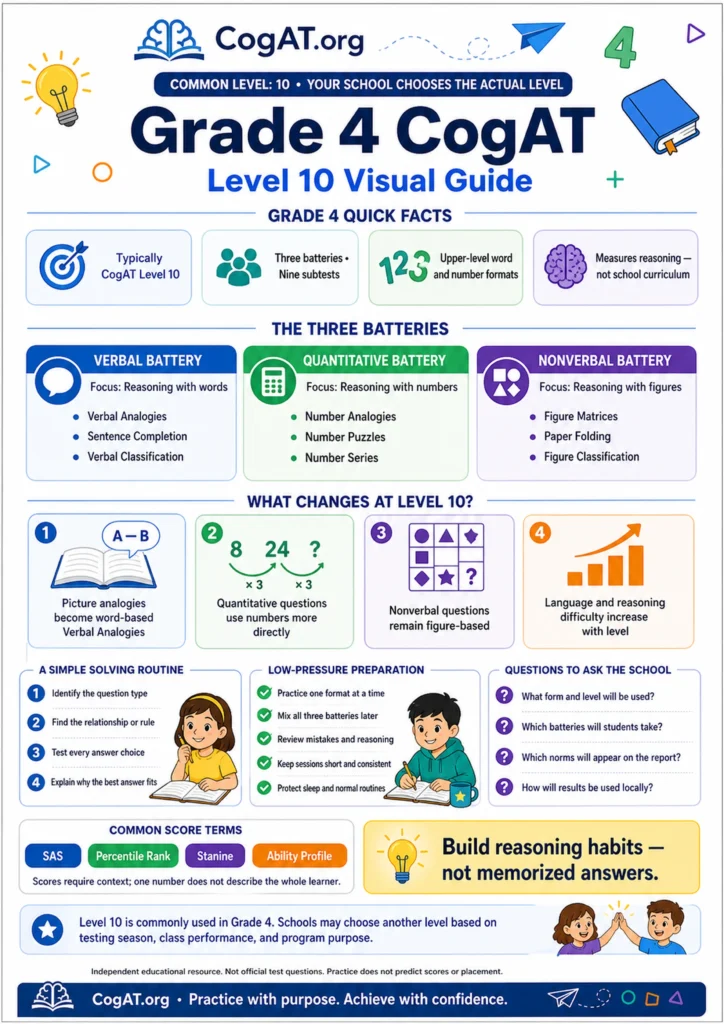
CogAT Level 10 is commonly used in Grade 4. It uses upper-level word and number formats across the Verbal and Quantitative batteries while retaining figure-based Nonverbal tasks. The school chooses the actual form, level, batteries, and purpose.
Editorial review: July 22, 2026
What CogAT level is commonly used in Grade 4?
Level 10 is the standard recommendation for most Grade 4 administrations. Official level-selection guidance allows schools to choose based on grade, testing season, average class performance, and program purpose, so families should verify the actual assignment rather than assuming it.
Three batteries and nine Level 10 subtests
Verbal Battery
Reasoning with words
Verbal Analogies, Sentence Completion, and Verbal Classification.
Quantitative Battery
Reasoning with numbers
Number Analogies, Number Puzzles, and Number Series.
Nonverbal Battery
Reasoning with figures
Figure Matrices, Paper Folding, and Figure Classification.
What changes at CogAT Level 10?
- Verbal Analogies: word relationships replace the primary-level Picture Analogies format.
- Verbal Classification: students compare categories and relationships among words.
- Quantitative formats: numbers appear more directly in analogies, puzzles, and series.
- Nonverbal formats: Figure Matrices, Paper Folding, and Figure Classification remain figure-based.
- Level calibration: language and reasoning difficulty are adjusted for the assessment level.
A simple Grade 4 solving routine
- Identify the question type. Name the subtest format before solving.
- Find the relationship or rule. Describe what changes and what stays consistent.
- Test every answer choice. Check the complete rule rather than choosing the first plausible answer.
- Explain the choice. State why the best answer fits and why alternatives do not.
How to prepare without pressure
Introduce one format at a time, then mix questions from all three batteries. Keep sessions short and consistent, review mistakes for reasoning rather than speed, and protect normal sleep and school routines. Practice should build familiarity with formats, not memorize answers.
Common CogAT score terms
Reports may include the Standard Age Score (SAS), percentile rank, stanine, and an Ability Profile. Each summarizes performance differently and requires context. A single score does not describe the whole learner, and local schools determine how results are used.
Questions to ask the school
- What CogAT form and level will be administered?
- Which batteries will students take?
- Will the report use age norms, grade norms, local norms, or a combination?
- How will results be used with other local evidence?
Frequently asked questions
What CogAT level is usually given in Grade 4?
Level 10 is commonly recommended for Grade 4, but the school chooses the actual level based on its testing plan.
What are the three Grade 4 CogAT batteries?
The batteries are Verbal, Quantitative, and Nonverbal. Each battery contains three subtests.
What verbal subtests are used at Level 10?
Level 10 uses Verbal Analogies, Sentence Completion, and Verbal Classification.
Does Grade 4 CogAT require reading?
The Level 10 Verbal Battery uses words and language. Quantitative and Nonverbal questions focus primarily on numbers and figures.
How should a Grade 4 student prepare?
Use brief original practice to learn each question format, explain reasoning, review mistakes, and later mix all three batteries.
What do SAS, percentile rank, and stanine mean?
They are different ways of reporting performance. SAS is age-standardized, percentile rank compares performance with a norm group, and stanine summarizes performance on a nine-point scale.
Can practice predict a CogAT score or gifted placement?
No. Practice cannot predict an official score, percentile, eligibility decision, or placement outcome.