Supplemental nonverbal reasoning practice. This activity builds related visual reasoning skills, but it is not one of the nine named core CogAT subtests.
Learn a systematic method for finding the missing piece in a visual pattern.
What this question type measures
Pattern Completion measures attention to visual detail and the ability to match lines, shapes, shading, and orientation across a missing area.
How to solve it
- Study every part of the prompt before looking at the choices.
- Name the relationship, rule, or change in simple words.
- Apply that same rule to the unanswered part.
- Eliminate choices that satisfy only part of the rule, then check the best answer.
Original practice example
A striped rectangle has a corner removed. The stripes continue diagonally downward from left to right. Which piece completes it?
Reasoning: The correct piece continues every stripe across both cut edges with the same spacing and direction.
Practice tips
- Ask the learner to explain the rule aloud before selecting an answer.
- Compare close distractors and identify exactly where each one breaks the rule.
- Practice accurately first; add timing only after the process is understood.
This is an original CogAT.org learning example. It is not an official or recalled test item.
How Pattern Completion questions work
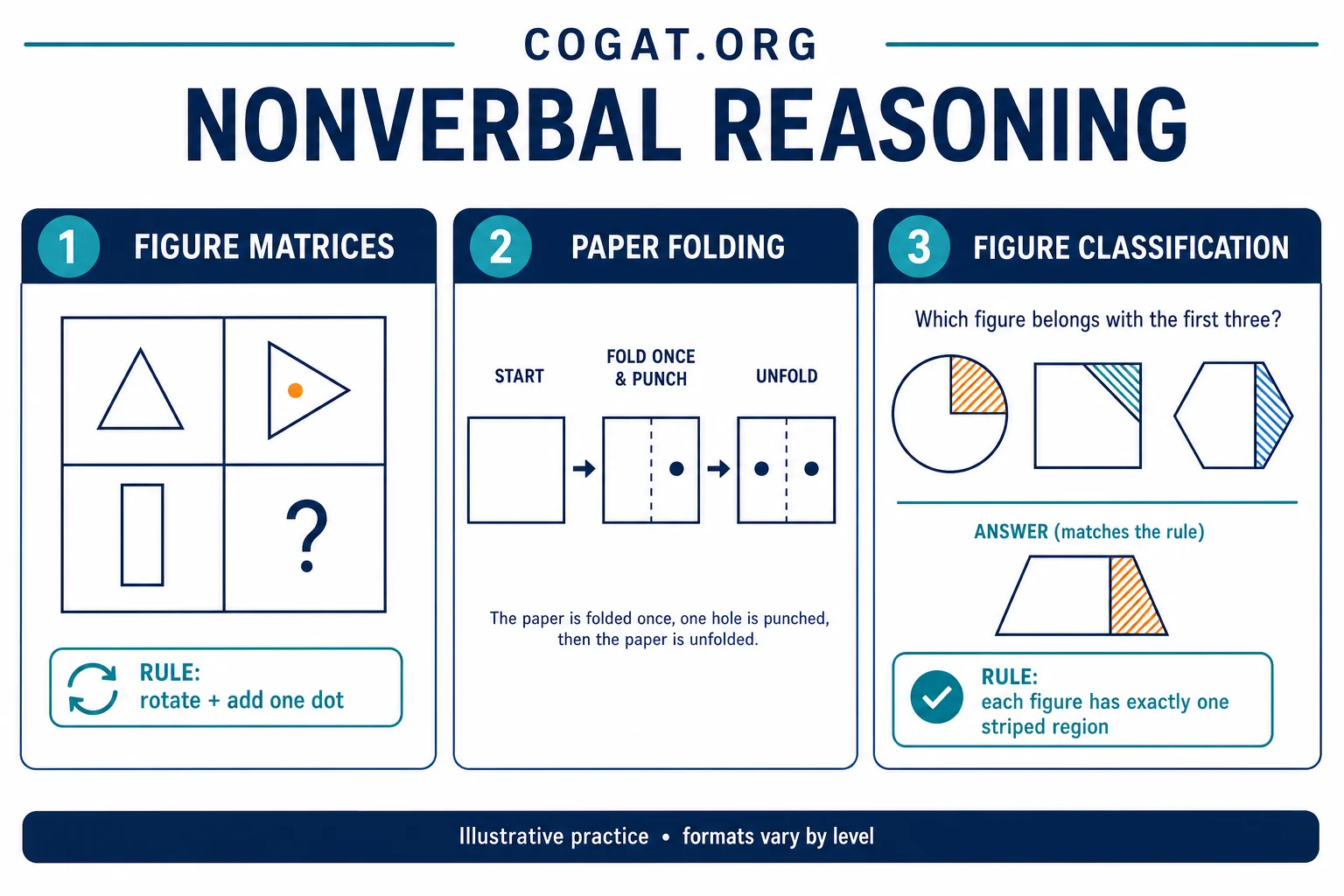
Pattern Completion is a related visual-reasoning practice skill, but it is not one of the publisher’s nine named CogAT subtests. Official Nonverbal Battery formats are Figure Matrices, Paper Folding and Figure Classification. Pattern-completion exercises can still build careful comparison of lines, orientation, shading and repeated forms.
Reasoning skills involved
- Visual discrimination and attention to small details
- Continuing lines, curves and repeated motifs across boundaries
- Tracking orientation, spacing, color and shading
- Eliminating pieces with one correct edge but another incorrect edge
A repeatable solving method
- Inspect each edge of the missing space.
- Note every line, color or shape that must continue across an edge.
- Compare candidates one boundary at a time.
- Check the surviving choice against the overall pattern.
Common mistakes to avoid
- Judging only the center of an answer piece
- Checking one boundary and overlooking the others
- Rotating a choice mentally when the displayed orientation must fit as shown
How to practice productively
Begin untimed and ask the learner to explain the rule or clue before choosing an answer. Review why each close distractor fails. Add short timed sets only after the method is accurate and familiar. This approach builds transferable reasoning instead of memorizing answers.
Independent educational resource: CogAT.org is not affiliated with or endorsed by the test publisher. Examples and practice materials are original and are not copied, recalled or secure test questions. Schools determine the assessment level, administration and use of results.