Parent and educator Kindergarten guide
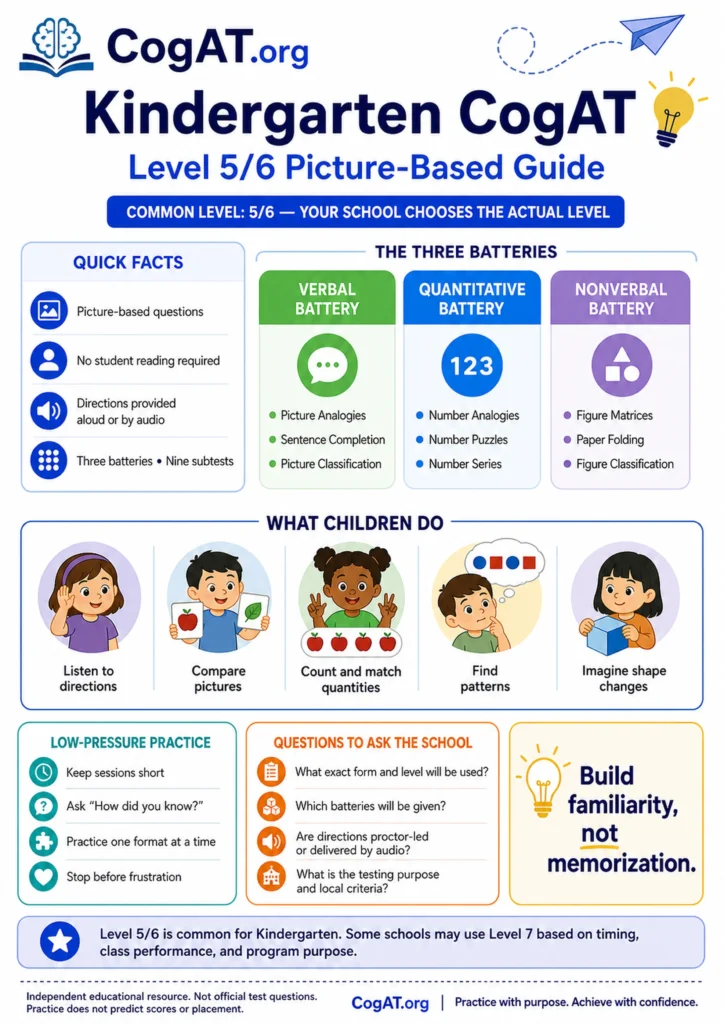
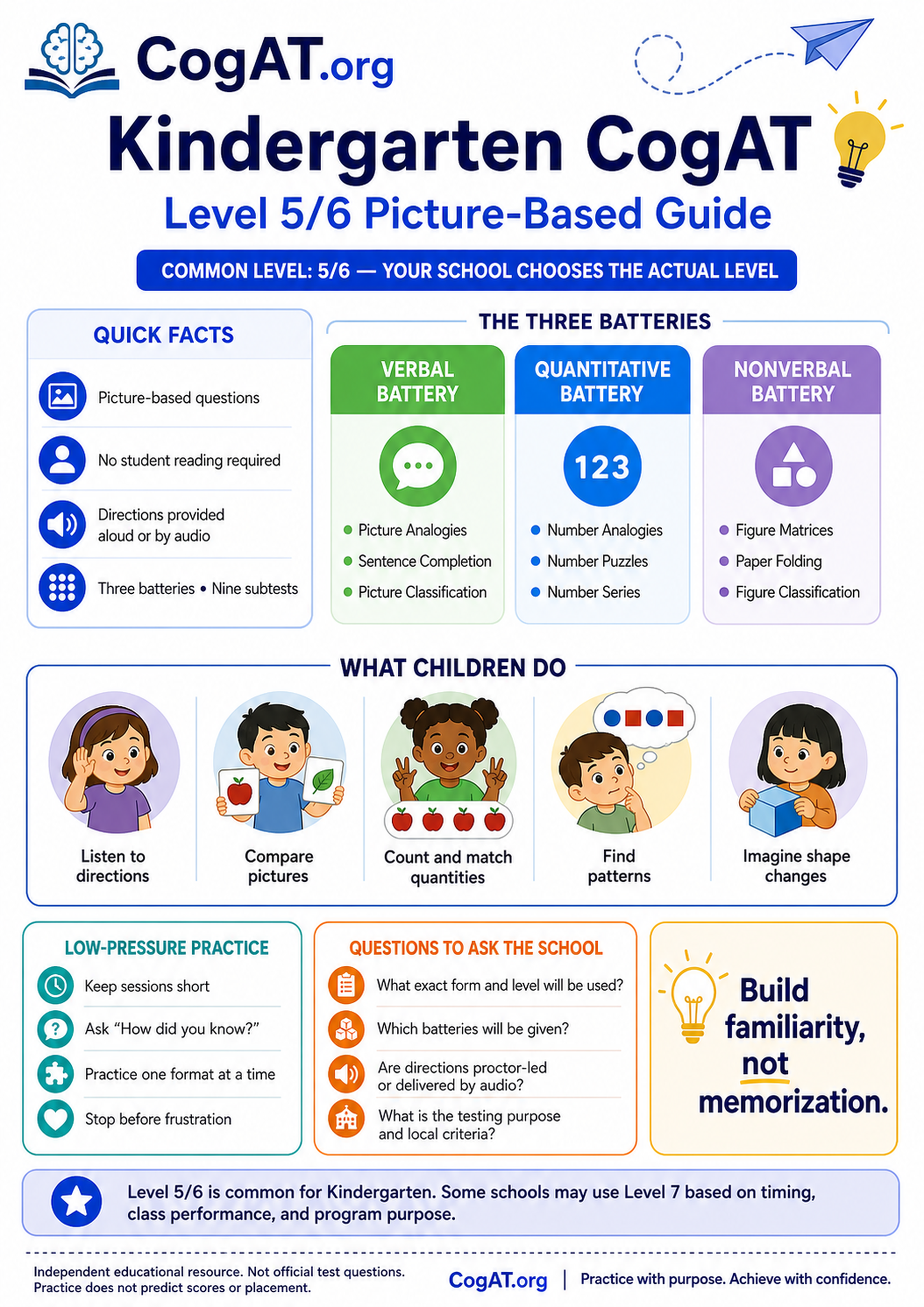
Kindergarten students commonly take CogAT Level 5/6. Its questions are picture-based and do not require students to read, but the school chooses the actual level and administration plan.
Editorial review: July 22, 2026
What CogAT level is used in Kindergarten?
Level 5/6 is the lowest available CogAT level and is commonly used for Kindergarten. Riverside Insights also notes that some higher-performing Kindergarten classes may use Level 7 depending on testing season and program purpose. Families should confirm the exact form, level, batteries, and testing purpose with the school.
Does Kindergarten CogAT require reading?
No. At Levels 5/6 through 8, the questions are picture-based and do not require students to read. Directions may be delivered by a proctor or through audio, depending on the school's administration setup.
Three batteries and nine Level 5/6 subtests
Verbal Battery
Reasoning with pictures and language
Picture Analogies, Sentence Completion, and Picture Classification.
Quantitative Battery
Reasoning with quantities
Number Analogies, Number Puzzles, and Number Series.
Nonverbal Battery
Reasoning with shapes
Figure Matrices, Paper Folding, and Figure Classification.
What Kindergarten children do
- Listen to directions before each new question format.
- Compare pictures to identify relationships and groups.
- Count and match quantities in visual number tasks.
- Find patterns in pictures, numbers, and figures.
- Imagine shape changes such as folds, holes, and rotations.
How to prepare without pressure
The goal is familiarity, not memorization. Keep practice brief, introduce one format at a time, ask the child to explain “How did you know?”, and stop before frustration. Use original practice rather than secure official test items.
Questions to ask the school
- What exact CogAT form and level will be used?
- Which batteries will students take?
- Are directions proctor-led or delivered by audio?
- What is the testing purpose and which local criteria apply?
Frequently asked questions
What CogAT level is usually given in Kindergarten?
Level 5/6 is common, but the school chooses the actual level. Some Kindergarten groups may use Level 7.
Does Kindergarten CogAT require students to read?
No. The Level 5/6 questions are picture-based and do not require student reading.
What are the three CogAT batteries?
The three batteries are Verbal, Quantitative, and Nonverbal. Each contains three subtests.
What subtests are in CogAT Level 5/6?
They are Picture Analogies, Sentence Completion, Picture Classification, Number Analogies, Number Puzzles, Number Series, Figure Matrices, Paper Folding, and Figure Classification.
How should families prepare a Kindergarten student?
Use brief, low-pressure practice to build familiarity with directions and question formats. Encourage the child to explain their reasoning.
Can practice predict a CogAT score or gifted placement?
No. Practice cannot predict an official CogAT score, eligibility decision, or placement outcome.