Original quantitative reasoning guide
Number Analogies ask students to find a quantitative rule that transforms one value into another, confirm that the rule works for every example pair, and apply it to a missing value. This guide covers both the pictorial primary format and the number-pair format used at later levels.
Editorial review: July 22, 2026
What are CogAT Number Analogies?
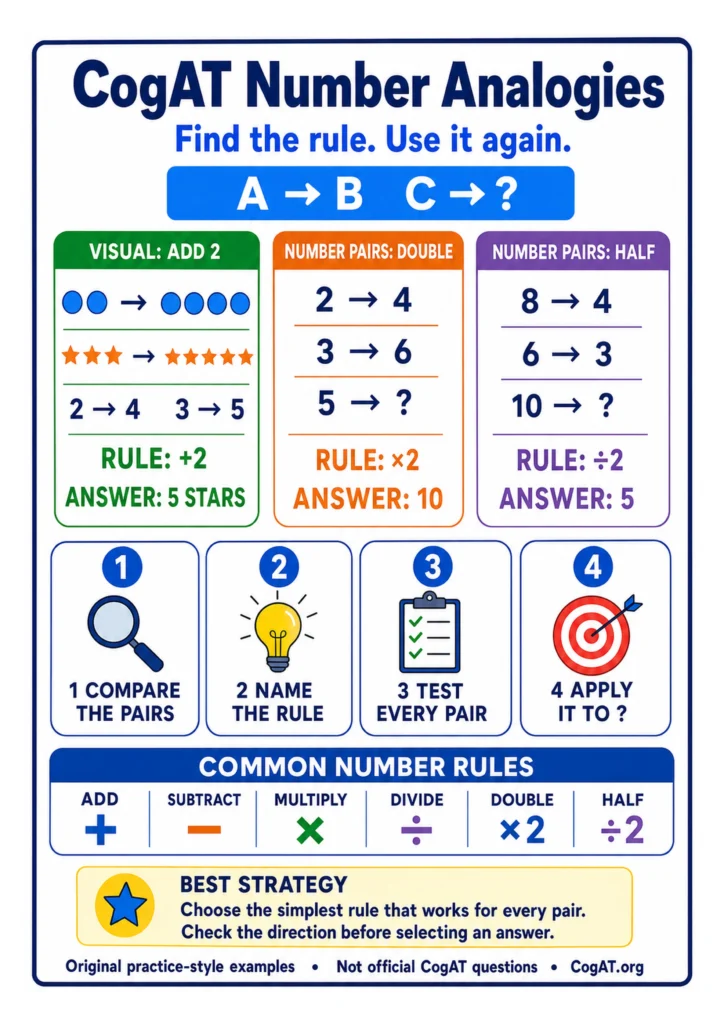
A Number Analogy compares quantities or numbers in pairs. The student identifies the operation that changes the first member of each pair into the second, tests that rule on the known pairs, and uses the same rule to find the missing value.
Number Analogies belong to the Quantitative Battery. At Levels 5/6 through 8, generally Kindergarten through Grade 2, questions use a two-by-two pictorial matrix with quantitative concepts. From Level 9 upward, students examine number pairs and determine the rule shared by the pairs.
A four-step Number Analogies strategy
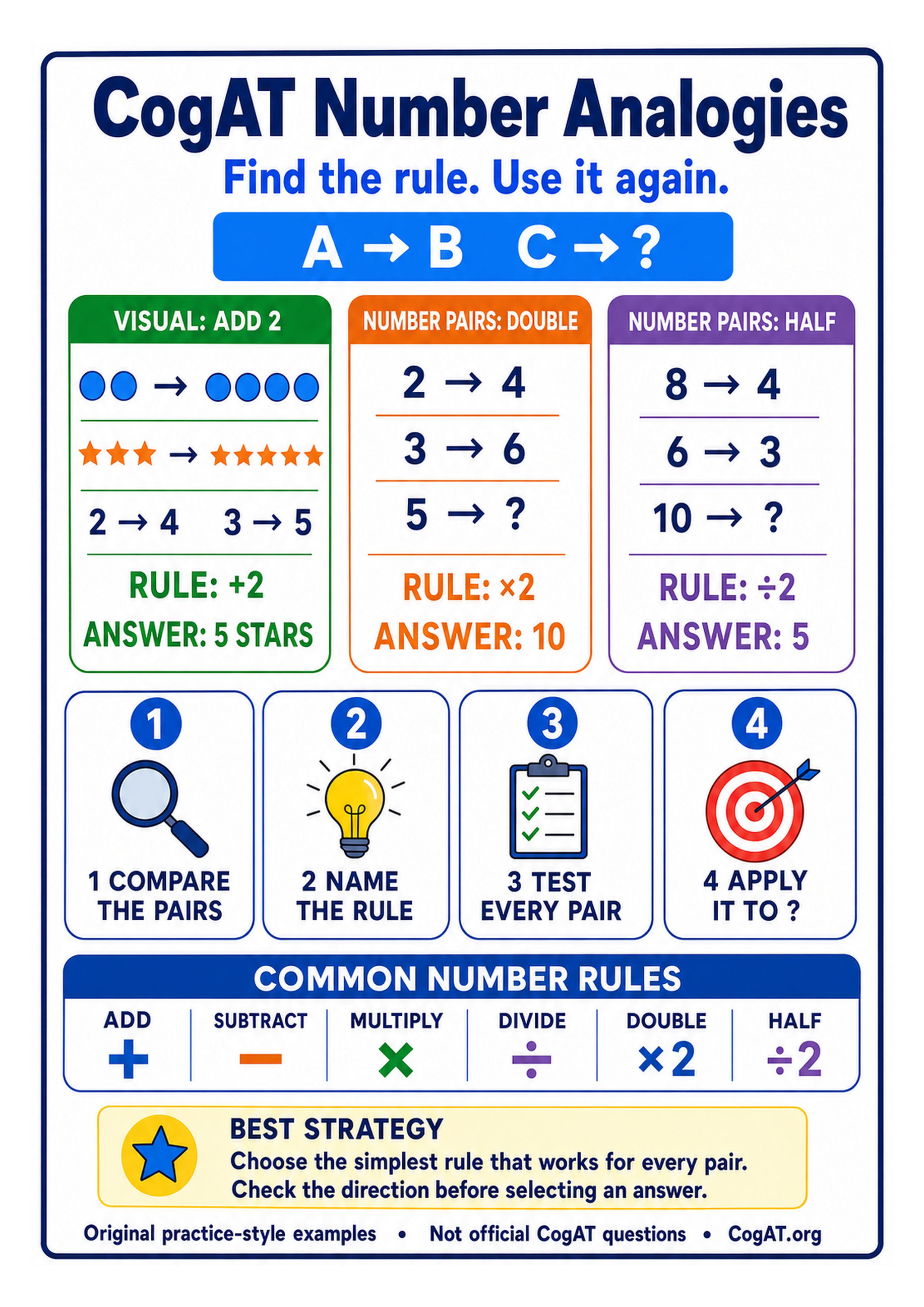
- Compare the pairs. Read each arrow in the same direction and note what changes.
- Name the rule. Try a simple operation such as add, subtract, multiply, divide, double, or half.
- Test every known pair. A valid rule must produce the second value in each example pair.
- Apply it to the missing value. Use the verified rule, then check the direction and arithmetic.
Three original CogAT-style Number Analogies examples
Pictorial: add 2
2 becomes 4, so 3 becomes 5
Two circles become four circles by adding two. Apply the same rule to three stars: 3 + 2 = 5 stars.
Number pairs: double
2 → 4 and 3 → 6, so 5 → 10
Each second number is twice the first. The rule works for both known pairs, so 5 × 2 = 10.
Number pairs: half
8 → 4 and 6 → 3, so 10 → 5
Each second number is half the first. Dividing 10 by 2 gives the missing value: 5.
Common Number Analogies rules
- Add: the same amount is added to the first value in every pair.
- Subtract: the same amount is removed from every first value.
- Multiply: each first value is multiplied by the same factor.
- Divide: each first value is divided by the same divisor.
- Double or half: common ×2 and ÷2 relationships.
- Two-step rules: some later-level items may combine operations; test the simplest valid rule first.
How parents and educators can help
Ask the student to say the operation aloud before choosing an answer: “add two,” “double,” or “divide by two.” This separates reasoning from guessing and makes arithmetic errors easier to spot.
When several rules seem possible, prefer the simplest rule that works for every known pair. Always check the arrow direction; “8 becomes 4” uses ÷2, while “4 becomes 8” uses ×2.
Frequently asked questions
Which CogAT battery includes Number Analogies?
Number Analogies are part of the Quantitative Battery, together with Number Puzzles and Number Series.
How does the format change by level?
Levels 5/6 through 8 use pictorial two-by-two matrices with quantitative concepts. Level 9 and higher use pairs of numbers that share a transformation rule.
What is the best first strategy?
Compare the known pairs in the same direction, try the simplest operation, and keep it only if it works for every known pair before applying it to the missing value.
Are these official CogAT questions?
No. The examples on this page were independently created by CogAT.org to teach general analogy reasoning. Secure or publisher-owned questions are not reproduced.
Can these examples predict a CogAT score or gifted placement?
No. Performance on a few practice-style examples cannot predict an official score, percentile, Ability Profile, eligibility decision, or placement outcome.